
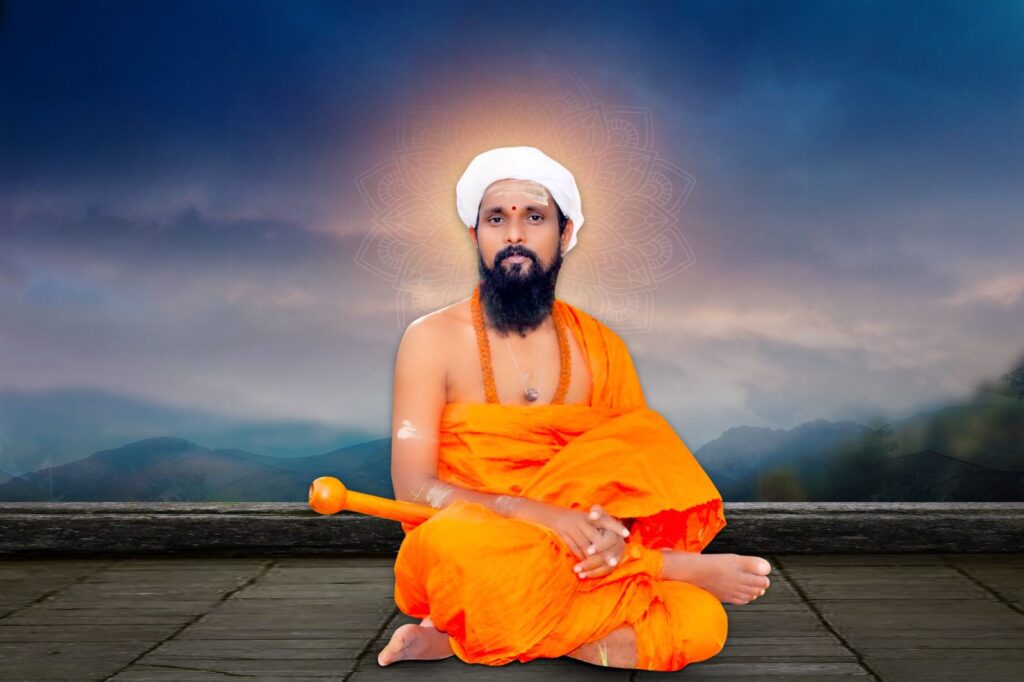
The ultimate title of Avadhoota is an achievement of many lifetimes of spiritual progress. Only a few rare souls merit such an exalted title. In any one epoch, only a handful of Avadhootas grace this Earth. To understand what an Avadhoota is, let us consider the meaning of the name itself and the essential characteristics of an Avadhoota.
“A”: He has achieved complete liberation from the bonds of desires, is absolutely pure, and is ever absorbed in total inner bliss.
“VA”: He has eliminated all his desires and is invulnerable to three kinds of problems: (a) diseases of the body, (b) illnesses caused by the poisons of creatures such as scorpions and snakes, and (c) the adverse effects of natural disasters such as floods and earthquakes. Avadhoota always lives in the present, forever happy with what each moment offers.
“DHOO”: Though an Avadhoota’s body may be smeared with dust or ashes, his mind is cleansed of all impurities. Having reached his goal, such an Avadhoota is beyond the mere disciplines of concentration (Dharana) and meditation (Dhyana).
“TA”: He is ever eternally engrossed in the contemplation of the Absolute Truth. To this end, he has abandoned all worldly activities and even their thoughts. Such a soul has erased his ego, merging completely with the universal spirit.
THE SEVEN STEPS (SAPTHA BHUMIKA) ARE:
1. *SUKHECHA (WISH FOR SPIRITUAL HAPPINESS)*:
– Approaching Gurus to know spiritual jnana and tatva, thinking about God, eager to know ‘Who am I?’
– After observing the futility of worldly materialistic life, feeling fed up with it and thinking ‘I have to get liberation (Moksha).’
– Knowing the unreality of this world, parents, wife, children; thinking about God; controlling sexual urges and mind with dispassion.
– Understanding that this worldly life is full of sorrow and tragedy; being ego-less; doing good deeds; being free of any attachment; leaving anger and lust, resulting in a mind full of bliss.
– Searching for and finding a Guru, showing reverence to the Guru, and requesting him to show the spiritual path.
– Wishing to know Athma, Yoga, and the means to achieve Athma Sakshathkara; gaining confidence to achieve it with the Guru’s help, and wishing to attain Athma Jnana.
2. *ATHMA VICHARA (ENQUIRY ABOUT SOUL)*:
– Doing service to the Guru; trying to find answers to the questions ‘Who am I?’, ‘Why am I born here?’, and ‘How is Athma, which is bliss, enveloped by a mind full of ignorance?’
– Asking, ‘For what reason am I born here?’, ‘Why am I ignorant?’, ‘Why am I entrapped in Samsara?’, ‘Why am I unhappy?’, ‘Why don’t I know the answers to all these questions?’
– Understanding what ego is; realizing false prestige due to ignorance; questioning what bad deeds prevent finding answers to questions regarding Athma.
– Learning from the Guru the meaning of the Veda Vakya ‘Tatvam Asi,’ deeply analyzing and thinking about Tatvas (Truths), and understanding there is no difference between Jeeva and Ishwara.
– Understanding that the mind-created Maya depends on Athma, i.e., Brahman, which is inside the body yet beyond it.
– Gaining knowledge of the body made of Panchikarana (combination of five elements), having Pancha Koshas, various body parts (Karmendriyas); all these are Kshethra, and knowing Athma is Kshethrajna.
– Acquiring knowledge of tatva (truth) through the Guru and trying to find ways and means of attaining Athma Sakshathkara.
– When the Guru observes the disciple to be of good conduct and character with a kind heart and blesses them, the disciple gains Jnana, which is Athma Vichara.
– Due to previous birth’s good deeds, doing Yoga under the Guru, and understanding ‘who am I’ is Athma Vichara.
3. *NISANGA (NON-ATTACHMENT TO MAYA, REMAINING AS ATHMA)*:
– Seeing Jyothi (divine light) in Hridayakasha; all karmas come to a stop, and understanding ‘I am that Jyothi’ is Nisanga.
– Understanding that Athma has no shape, no characteristics; all you see is Athma, full of bliss, no directions, and of the nature of Sat-Chit-Ananda is Nisanga.
– Just as rays of sunlight merge in themselves, Athma being Brahman, many tatvas are born and merge in it; understanding how ‘I am connected with it’ is Nisanga.
– Just as a mirage is seen and then merges in itself, in my divine light the world is seen and then merges in itself is Nisanga.
– Just like lightning is seen in clouds and then merges in them, so also many universes being born and merging, Maya is seen then merging in itself, many other things projected by the mind then merging in the mind; knowing how they are connected is Nisanga.
– Realizing that body, mind, money, fate, sleep, blame, show-off, hope, prestige, defect, prohibition—I have no connection with all these—is Nisanga.
– Forgetting arguments about the body and soul, understanding dream-like Maya, blaming birth/death, knowledge born in Hridayakasha is Nisanga.
4. *VASANAKSHAYA (REMOVAL OF IMPEDIMENTS)*:
– When all vasanas are eliminated by the knowledge of what is real and unreal, seeing only one Athma in different names and forms in this world, the knowledge ‘I am Brahman’ is Vasanakshaya.
– Killing the wavering mind’s belief in character, intellect, right, wrong, childish play, behavior, boldness, etc., and merging in Yoga is Vasanakshaya.
– When vasanas from previous many births are destroyed as mentioned above, and remaining as Athma is Vasanakshaya.
– When all vasanas are removed through Yoga and in Hridayakasha, seeing Athma as light is Vasanakshaya.
– Understanding that the world you see is unreal like a dream, seeing God in everything, knowing that Athma is Brahman is Vasanakshaya.
5. *MUKTHI-ANANDA (LIBERATION-HAPPINESS)*:
– Merging the mind in Athma, free of any thought, full of bliss, and moving about as if in sleep is Ananda; when not moving about, it is called Yoga Nidra, which is also Ananda.
– When food, sleep, fear, and sexual urge have vanished due to a mindless state, being as if without a body, immersed in the bliss of Athma is Ananda.
– Seeing everything in Maya as Brahman and being happy is Ananda.
6. *THURIYA (FOURTH STATE OF BLISS)*:
– When the mind merges in Athma and sees Brahman in all, that yogi is Jeevanmuktha, not having the three states of Jagrath, Swapna, Sushupti; getting rid of ignorance, eliminating vasanas, and a mind free of sex and lust is Thuriya.
– Achieving liberation and the sadaka joining that status by spiritual advancement is Thuriya.
– Knowing nothing other than Athma, being only a witness to happenings around him, thinking ‘I am Athma, which is Brahman,’ is Thuriya.
7. THURIYATHITA (HIGHEST STATE-NO THOUGHTS):
– This state is also called ‘Videha Muktha’ (please refer to our posting ‘Videha Muktha’).
– The sadaka, having achieved Mano Nasha (destruction of the mind), no longer has the thought ‘I am Athma’ or ‘I am in a body.’
– He is living as a god. This state cannot be understood by others nor explained to others. You have to achieve it to understand it. He is verily living as ‘Aham Brahmasmi’ and ‘Tatvam Asi.’ There is no higher state than this.
These are the seven stepping stones to sit on the throne called ‘Avadhoota.’
